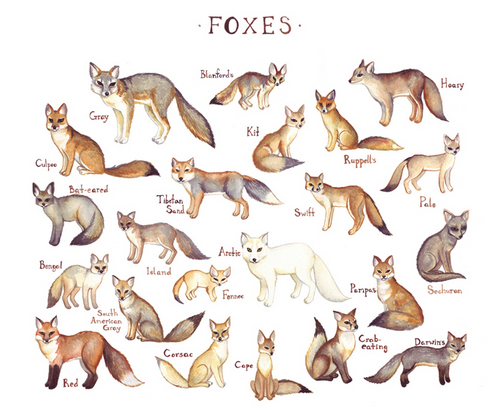
MATING AND REPRODUCTION HABITS
Artic Fox –
The arctic fox tends to be active from early September to early May. The gestation period is 52 days. Litters tend to average 5–8 kits but may be as many as 25 (the largest in the order Carnivore. Both the mother and the father help to raise their young. The females leave the family and form their own groups and the males stay with the family. Litters are born in the early summer and the parents raise the young in a large den. Dens can be complex underground networks, housing many generations of foxes. Young from a previous year's litter may stay with the parents to help rear younger siblings. The kits are initially brownish; as they become older they turn white. Their coat of fur also changes color when summer arrives, but in winter it is white. The mortality rate for the fox is very high. More than half will die before they are 10 months old. Many fox don’t live more than a few years in the wild due to the conditions. However, they can survive up to 14 years in the wild with the right conditions. They have been known to live up to 20 years in captivity.
Swift Fox
The adult swift fox's breeding season varies with region. In the southern United States, it mates between December and February with pups born in March and early April, while in Canada, the breeding season begins in March, and pups are born in mid-May. The male swift fox matures and may mate at one, while the female usually waits until her second year before breeding. Adults live in pairs, and although some individuals mate for life, others choose different partners each year. Gestation takes around 51 days, and four to five kits are born
Kit Fox
Male and female kit foxes usually establish monogamous mating pairs during October and November. Pairs can change year to year. They mate from December to February, when they use larger family dens.[clarification needed] Litters are born throughout March and April, usually containing one to seven pups, and average four pups. The gestation is 49 to 55 days. Pups do not leave the den until they are four weeks old. They are weaned after about eight weeks and become independent at five to six months old. They become sexually mature at 10 months. Both parents take part in raising and protecting their young. The average lifespan of a wild kit fox is 5.5 years. In captivity, they can live 12 years.
Gray Fox
The gray fox is monogamous. The breeding season of the gray fox varies geographically; in Michigan, the gray fox mates in early March, in Alabama, breeding peaks occur in February.[12] The gestation period lasts approximately 53 days. Litter size ranges from 1 to 7. Kits begin to hunt with their parents at the age of 3 months. By the time they are 4 months old, the kits will have developed their permanent dentition and can now easily forage on their own. The family group still remains together until autumn when the young reach sexual maturity. Then, they disperse.
POPULAR CULTURE
In many cultures, the fox appears in folklore as a symbol of cunning and trickery, or as a familiar animal possessed of magic powers.
In Dogon mythology, the pale fox is the trickster god of the desert, who embodies chaos.[1][2]
The Medieval Norman adventurer Robert Guiscard was nicknamed "Robert the Fox" as well as the Resourceful, the Cunning, the Wily - underlining the identification of such qualities with foxes.
The term "foxy" in English is defined as meaning - as the obvious "having the qualities of a fox" - also "attractive" and "sexy", as well as "red-haired".[3] And "to outfox" means "to beat in a competition of wits", the synonym of "outguess", "outsmart" or "outwit".[4]
Movies
- 1937 - Ladislas Starevich's puppet-animated feature film, Le Roman de Renard ("The Tale of the Fox").
- 1940 - Disney's Pinocchio: J. Worthington Foulfellow (also known as Honest John, and ironically is extremely dishonest).
- 1941–1950 – Screen Gems The Fox and the Crow: Fauntelroy Fox, one of the principal characters of the animated film series.
- 1946 - Disney's Song of the South: Brer Fox.
- 1960 - Hanna Barbera's Yogi Bear series had short cartoons, Yakky Doodle, in which the duckling is pursued by Fibber Fox.
- 1964 - The Irish-accented fox from Disney's Mary Poppins
- 1972 - Ralph Bakshi's 1972 film Fritz the Cat: Winston Schwartz, the on-and-off-again girlfriend of Fritz.
- 1973 - Disney's Robin Hood: Robin Hood and Maid Marian
- 1973 - Zuiyo Eizo episodes Fables of the Green Forest based on a book The Green Forest.
- 1981 - Disney's The Fox and the Hound: Tod and Vixey; there was a 2006 sequel The Fox and the Hound 2 and being the first in media that attacks a dog and a bear.
- 1981 - Attila Dargay's Vuk, a young fox who is one of the most famous Hungarian cartoon characters.
- 1982 - The Plague Dogs, based on the book.
- 1983 and 1997 – Encore Enterprises' animated series Chucklewood Critters: fox character Rusty.
- 1985 - A French animated series, Moi Renart.
- 1986 – Hospital Radio's The Space Gypsy Adventures: D.C. Bones, D.C. Fusky, Gemma and Damien Mildury (animated).
- 1986 - Dutch TV series The Bluffers: Sharpy, one of the main protagonists.
- 1987 – Sunbow Productions' serial Visionaries: Knights of the Magical Light: Ectar of the Spectral Knights possessed the totem of the Fox.
- 1987 – Sylvanian Families: The members of the Slydale Family are Slick, Velvette, Buster, Scarlett, Skitter and Lindy from the animated TV series.
- 1987 – Maple Town: The members of the Fox Family are Fanny, Freddy, Mr. and Mrs Fox from the animated series.
- 1990 – Disney's Talespin: several fox characters appear in the series.
- 1990-91 - Samurai Pizza Cats ( Kyatto Ninden Teyandee) : who's main antagonist Kitsunezuka Ko'on-no-Kami a prime minister in Edoropolis (In the original Japanese version he's a Fox but in the Saban English version he's known as Seymour "The Big" Cheese a Rat).
- 1991 – Don Bluth's Rockadoodle, based on Chantecler by Edmond Rostand, a tale about a rooster; one of antagonists of the story is a fat fox named Pinky.
- 1991 – TV series Bucky O'Hare: Vixen Captain Mimi LaFloo; based on 1970s comics.
- 1992/2006 – Operation Lifesaver Video Sly Fox and Birdie teaches kids about railroad safety
- 1993–1996 – The Animals of Farthing Wood TV series and movie: Fox and his mate Vixen.
- 1993, 1996 and 2007 – Flemming Quist Møller's Danish animated films Jack from the Jungle: Rita, an urban fox.
- 1993 – Tezuka's Akuemon: Anime based on Japanese folk tale about fox-wife.
Books
- 1908 and 1912 - Beatrix Potter included foxes in her anthropomorphic children's tales—as pursuer in The Tale of Jemima Puddle-Duck and as title character in The Tale of Mr. Tod.
- 1913 - Thornton W. Burgess's The Green Forest: Reddy Fox.
- 1924 - Aquilino Ribeiro, Romance da Raposa: Portuguese adaptation of the medieval story of Reynard.
- 1961 - Peter Spier, The Fox Went Out on a Chilly Night: an adaptation of the folk song of the same name.
- 1963? - Miyoko Matsutani, The Bread with Color of the Fox's Tail: story about friendship between a girl and a boy-werefox.
- 1970s - Richard Scarry, series of books, Fixit Fox, a mechanic; also animated
- 1970 - Roald Dahl, Fantastic Mr. Fox: Mr. and Mrs. Fox and their four pups.
- 1982 - William Steig's children's book Dr. Desoto contains an unnamed vulpine patient.
- 1990 - Judith Mellecker, The Fox and the Kingfisher: Picture book about brother and sister who tried to run away from stepmother and changed their selves into a fox and a bird.
- 1998 - Michel Gagné, A Search for Meaning—The Story of Rex : Continues in comics magazine Flight (comic)
- 2006 - Ali Sparkes, Finding the Fox: the first of a series of novels about a boy who has the ability to change into a fox.
- 1900s - Irina Korshunow, The Foundling Fox: Picture book about a fox who loses his parents and is adopted by another mother.
- 1965 - Dr. Seuss, "Fox in Socks". Dr. Seuss' story about tongue-twisters.
- 1966 - David Thomson, "Danny Fox" An episodic journey story in which the wily Danny Fox seeks food for his wife Mrs Doxie Fox and hungry children Lick, Chew and Swallow. Loosely based on Folk tales, two more books followed;
- 1968 - David Thomson, "Danny Fox meets a Stranger", in which Danny Fox meets and pits his wits against a Wolf
- 1976 - David Thomson, "Danny Fox at the Palace" Danny Fox meets royalty, although not for the first time.
- 2013 - Ylvis and Svein Nyhus, "What does the Fox Say?", picture book based on the YouTube hit
Documentaries
Urban fox documentary / film - Pssst Fox by Richard Cobelli
Articles
Kit foxes make themselves at home within Bakersfield city limits
February 19, 2012 | By Steve Chawkins, Los Angeles Times
Like lovers in Paris, San Joaquin kit foxes will always have Bakersfield. The rare little foxes come out mostly at night. They find fabulous food everywhere: chunks of cheeseburger from dumpsters, shreds of taco on windblown wrappers. And the accommodations: What can beat a cozy den in the student quarter — specifically, beneath portable classrooms in the Panama-Buena Vista Union School District? The 17,000-student district isn't crazy about the foxes, especially when about one-third of its 23 elementary and junior high schools have to deal with them on a regular basis.
Arctic fox
The Arctic fox, also known as the polar fox, is a small fox native to cold Arctic regions of the Northern Hemisphere.
It is common in all three tundra biomes.
The Arctic fox has evolved to live in the most frigid extremes on the planet.
Among its adaptations for cold survival are its deep, thick fur, a system of countercurrent heat exchange in the circulation of paws to keep them from freezing, and a good supply of body fat.
Arctic foxes will eat pretty much anything.
Their prey includes voles, lemmings, hares, ground squirrels, and bird eggs.
Foxes living on the coast also eat shellfish, sea urchins, dead seals and fish, beached whales, and nesting seabirds.
In winter when food is scarce, they may follow a polar bear and after the bear makes a kill, eats and leaves, they will steal what ever scraps of meat are left.
MISCELLANEOUS FACTS
Contact Us | AddressLora House Near Priya Street |
